If you run a dental practice in Bristol County, you already know the pattern. The phone rings at 6:47pm on a Tuesday. Nobody's there because the front desk goes home at 5. The caller is a new patient with a cracked molar, the most lucrative kind of new-patient call a practice gets, and she hangs up after three rings and calls the office on the corner of Faunce instead. Your voicemail catches it. She does not call back the next morning.
If you want to hear what the AI version of that 6:47pm call sounds like, I published a real annotated transcript from a build I did for a practice off Faunce Corner. The article walks through what's happening underneath each turn, plus the bad version of the same call for contrast.
Multiplied across an average week, this is somewhere between $8,000 and $15,000 a month in missed revenue for a single-location practice. The Peerlogic study above quantifies the call-volume side. The financial side scales with whatever a new-patient case is worth in your market. For a Dartmouth practice averaging $1,200 in first-year value per new patient, twenty missed monthly calls is $24,000 in trailing revenue.
What I'd build for a dental practice.
The build clusters around three pieces. Most practices start with the first.
1. After-hours AI receptionist
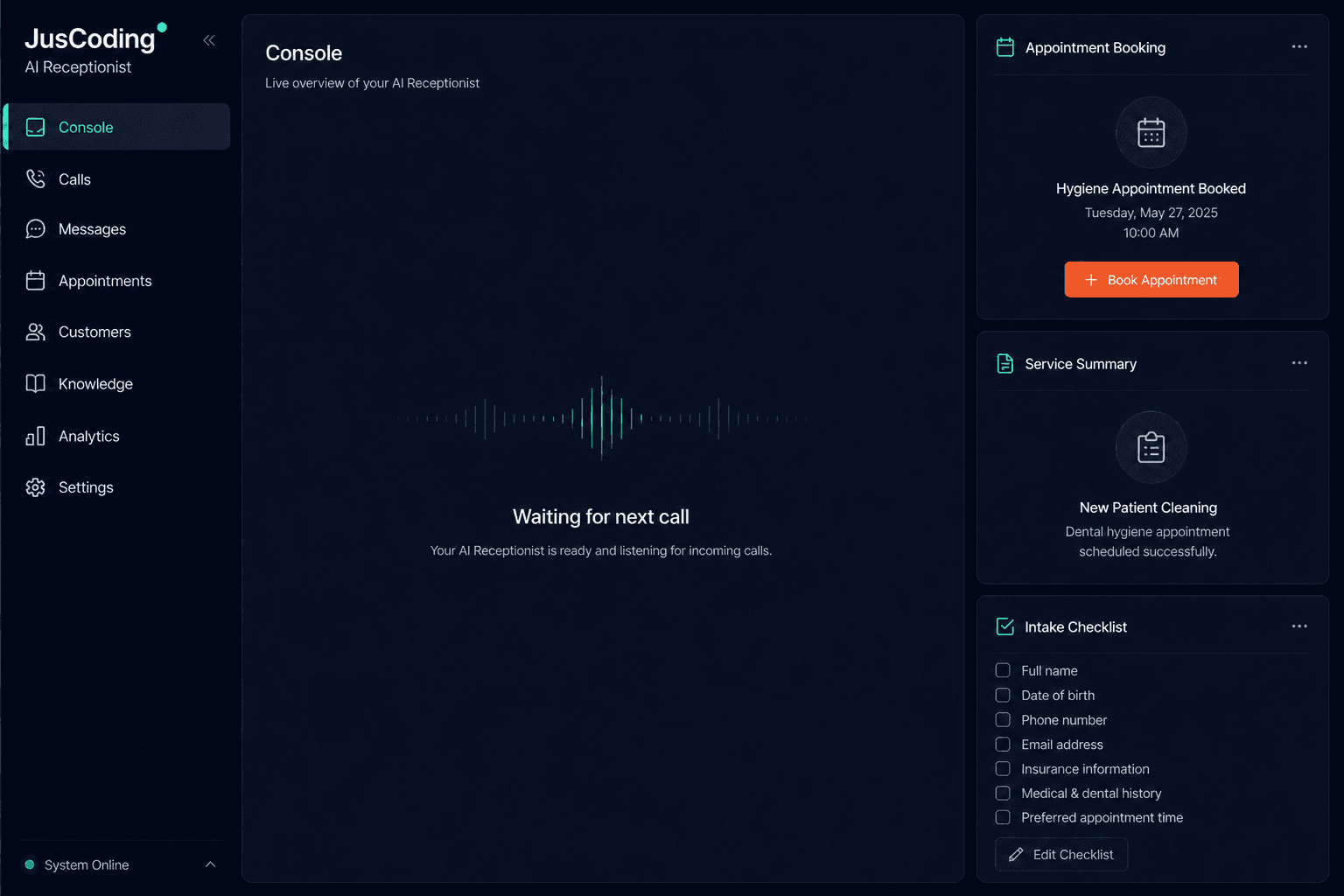
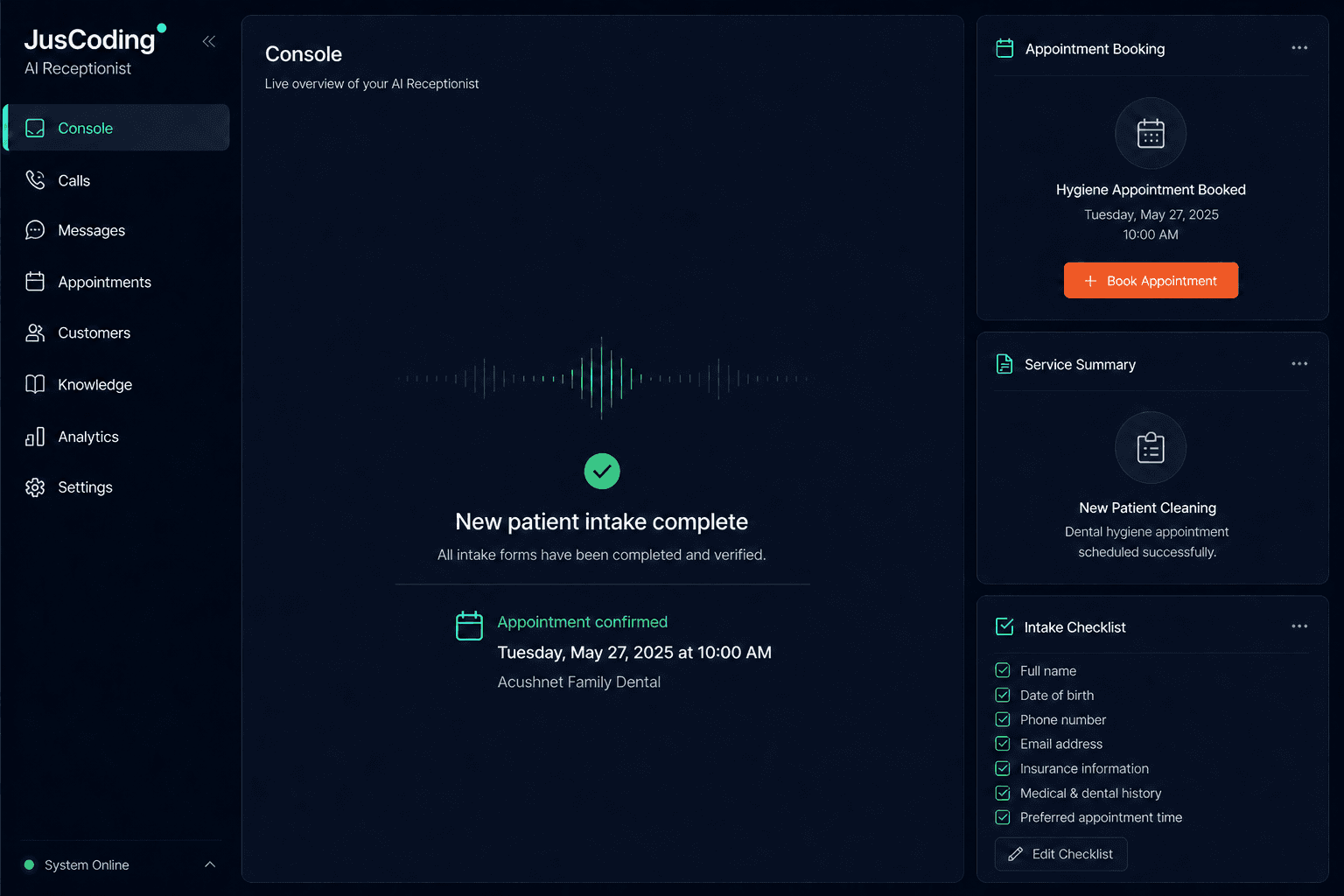
A voice AI that answers your phone (or your dedicated after-hours line) when nobody's at the desk. Sounds like a real person. Handles the common cases: new-patient inquiries, appointment reschedules, insurance questions, hours and directions. Books cleanings directly into your scheduler (Dentrix, Eaglesoft, Open Dental, Curve, Denticon, whichever). Routes urgent issues like cracked molars or abscesses to your on-call number with the patient's contact info already captured.
Not a phone tree. Not a script. The system actually understands "yeah I lost a crown last weekend and my insurance changed in January, what do I need to know" and handles it correctly.
2. Missed-call recovery
For the calls that come in during business hours but ring out (front desk on another line, in the back, on lunch). The system catches the missed call, sends a personalized text within two minutes, and offers to either text-schedule or call back. Recovers roughly 30-45% of missed calls based on industry data on text-back response rates.
3. Reactivation outreach
The unglamorous one nobody talks about. The system pulls patients overdue for cleanings (90+ days) from your scheduler, drafts a friendly reminder text, and either books the appointment or hands the warm lead to your front desk. For a practice with a 1,500-patient active roster, this typically surfaces 20-40 reactivations per month that would otherwise have churned.
How it plays out.
From 22 missed evening calls a week to 4.
Two-doctor practice with one front desk staff. Open 8 to 5, Monday through Thursday, plus Friday mornings. Roughly 22 missed calls per week outside hours, mostly during the 5pm-7pm window when patients are getting home from work. Practice owner had been considering an answering service ($400-$600/month) but worried about call quality.
Build: AI receptionist on the after-hours line, integrated with their existing Eaglesoft. Captures the new-patient calls, books cleanings directly, routes the two or three weekly emergencies to the on-call doctor. Plain-English documentation for the front desk team.
Reactivation outreach surfaces $18K of overdue cleanings in month one.
Three-hygienist practice with a 1,800-patient active roster. Hygienists report consistent 5-10% no-show rates and a long tail of patients who fall off the recall schedule and never come back. Front desk does outreach when they have time, which is rarely.
Build: Operations bot pulls overdue patients from the practice management system weekly, drafts age-appropriate reminder texts (different language for parents of toddlers vs. teenagers), and either books or escalates. Front desk reviews and approves before send.
Start with the $200 audit.
15 minutes describing your practice, your scheduler, and your current after-hours setup. I send back a one-page playbook with what to build, what it'd cost, and a real estimate of monthly recovered revenue based on your actual call volume. The $200 credits if you hire me.
Book the audit →What it costs.
Practice audit
15-minute call plus written one-page roadmap. Real revenue estimate based on your call data. Credits toward build.
AI receptionist build
After-hours AI receptionist + missed-call recovery. Integrated with your scheduler. HIPAA-compliant. Live in 10-14 days. 60 days of support.
Receptionist + reactivation
Everything above plus the reactivation outreach bot. For practices with 1,000+ active patients and an underused recall list.
Compared to subscription AI receptionists ($199-$975/month forever, see the real cost article), a custom build pays back the difference inside 12-18 months and you own the system.
What makes this different from the AI agencies pitching you.
If you've gotten cold-called by an "AI agency" recently (and most South Coast practice owners have), you've probably been quoted $4,500 for a build plus $200-$400 a month in "maintenance fees." That setup is almost always app-stitched no-code workflows that break in 90 days. There's a whole article on the pattern.
JusCoding builds custom code. Real software, written for your practice, deployed to your accounts (your phone number, your scheduler, your CRM). No required monthly fees. If you ever want to take it to another developer, you can. The differences show up in three places:
- It actually works. Custom code handles edge cases. Stitched workflows break when an insurance question doesn't fit the script.
- It costs less to operate. Direct API calls are 60-80% cheaper than no-code middlemen. You're not paying Make.com or Zapier rent forever.
- It's actually yours. When the build is done, you own the code and the accounts. You're not held hostage to the agency's monthly fee to keep things running.
FAQs from practice owners.
Will this work with Dentrix or Eaglesoft?
Yes. Both have APIs (Dentrix more openly, Eaglesoft via Patterson's developer access). The build integrates directly. Open Dental, Curve, and Denticon are also supported. If you're on a niche or proprietary system, the audit call confirms the integration path.
What about HIPAA?
All builds use HIPAA-compliant infrastructure. Signed BAAs with the AI model provider and telephony vendors. Encrypted call recordings. No PHI sent through non-compliant tools. Compliance is part of the build, not an upcharge.
Will it sound like a robot?
No. Modern voice AI sounds like a person. Most patients don't realize they're talking to AI unless told. The system handles natural language, including reschedules, insurance questions, and emergencies. We script the persona to match your practice's tone.
What happens if the AI gets confused?
Two failure modes built in. For non-urgent confusion, the AI takes a message and books a callback. For anything that sounds urgent (pain, swelling, trauma), the system immediately routes to the on-call number with the patient's name and number already captured. No patient gets stuck talking to a system that can't help them.
How long until it's live?
10-14 days for most builds. Day 1 is the discovery call (where you also see a working demo of the relevant pieces). Days 2-10 is the build. Days 10-14 is testing and your team's walkthrough. Day 15 is live.
Peerlogic 2026 dental call analytics study, 4,280-call sample, 38% miss rate: peerlogic.com
HIPAA technical safeguards for cloud-based AI: HHS guidance, 2024 update.
Book the 20-minute call. I'll demo a dental build live.
By the end of the call, you've heard a working version of the AI handling a real new-patient inquiry. If it doesn't impress you, you don't hire me. If it does, I quote you a flat fee on the spot or by email within 24 hours.
Book the call →— Justin, from a converted spare bedroom in New Bedford