Most "AI agencies" pitching small businesses in New Bedford, Dartmouth, and Fairhaven are not actually building AI. They're stitching together Make.com, Zapier, OpenAI, Twilio, and Calendly with no-code glue, slapping a custom-build price tag on it, and walking away when it breaks 90 days later. There's a whole article on the pattern.
JusCoding is the version where the work is real software, written for your business, calling APIs directly, deployed to infrastructure you own. The difference shows up in three places: it actually works, it costs less to run, and you keep it after I'm gone.
Here's what I actually build.
What I build.
Three things, mostly. Sometimes combinations. Always custom code.
1. AI receptionist
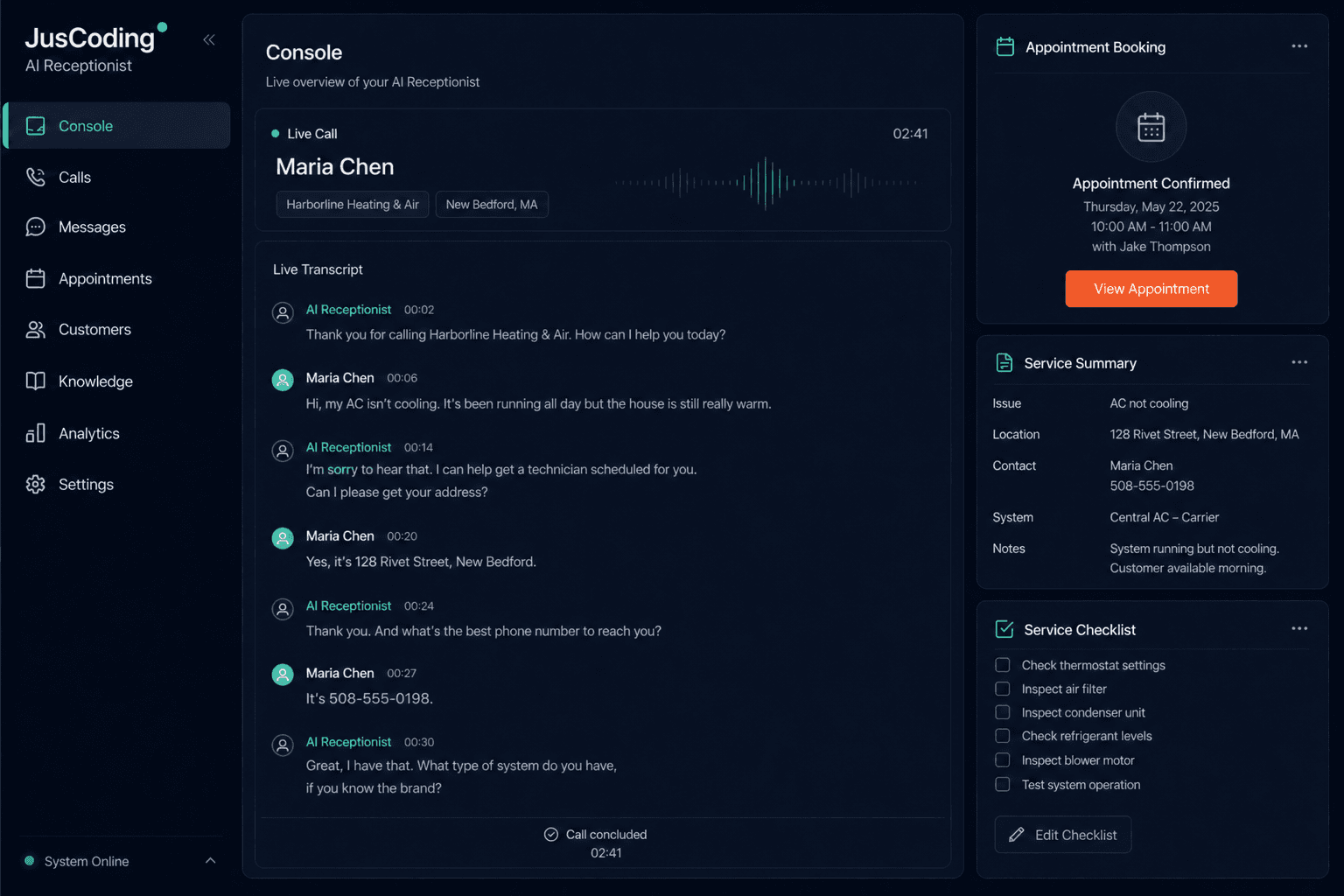
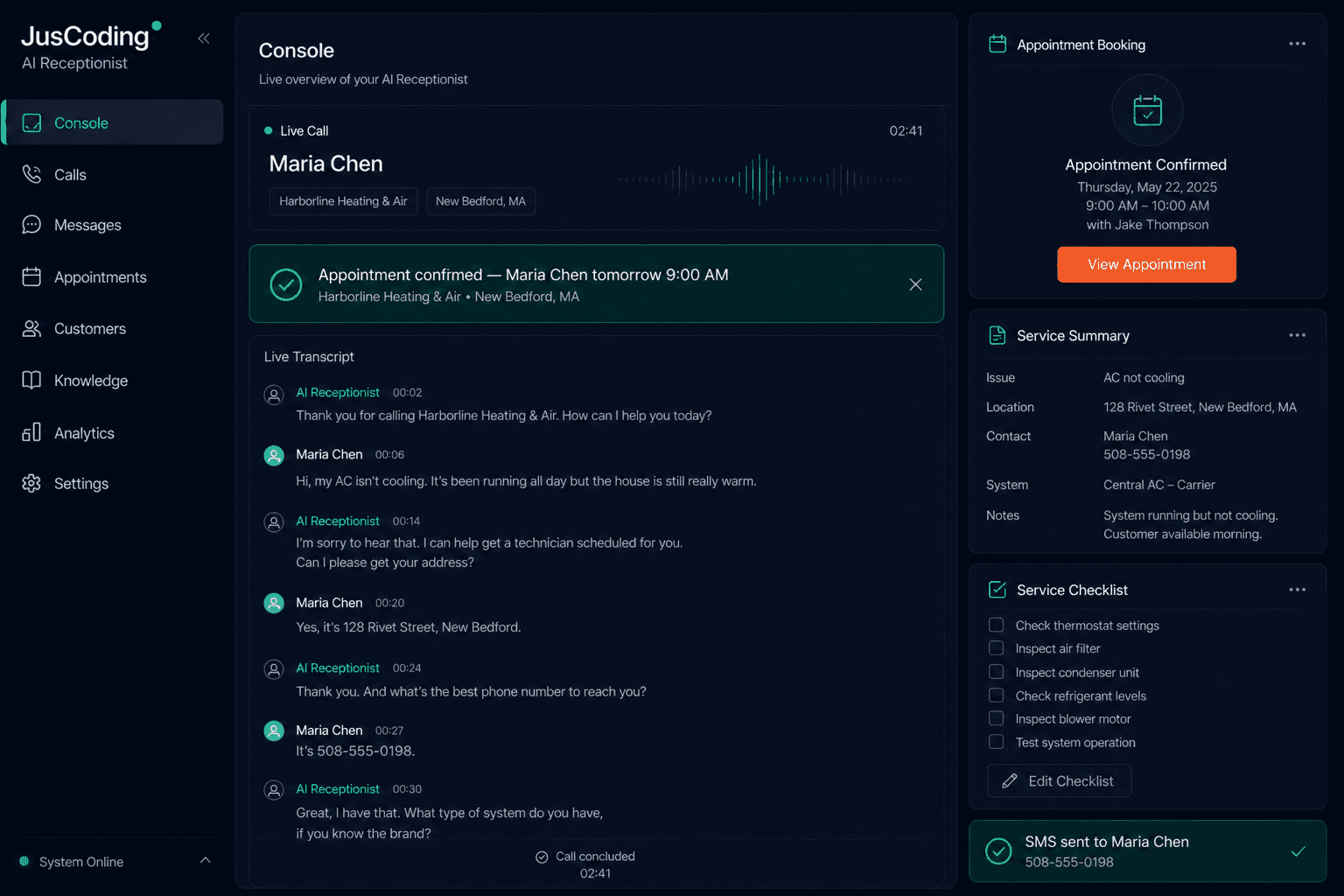
A voice AI that answers your phone (or your after-hours line), handles common requests intelligently, and books appointments directly into your scheduler. Not a script. Not a phone tree. The system actually understands "yeah I need to reschedule my appointment to like, the same time but two weeks later, but actually if you have anything earlier in the morning that'd be better" and handles it correctly.
For a dental practice in Dartmouth losing roughly $11,000 a month in missed after-hours calls (the Peerlogic 2026 study put the dental industry's average miss rate at 38% across 4,280 calls), an AI receptionist that captures even half of those is paying for the build inside the first month.
If you want to know what one of these actually sounds like (the most common objection is that they sound robotic), I published a real annotated transcript from a build I did for a Dartmouth practice. Reading it is the fastest way to understand what's possible.
2. Lead-response automation
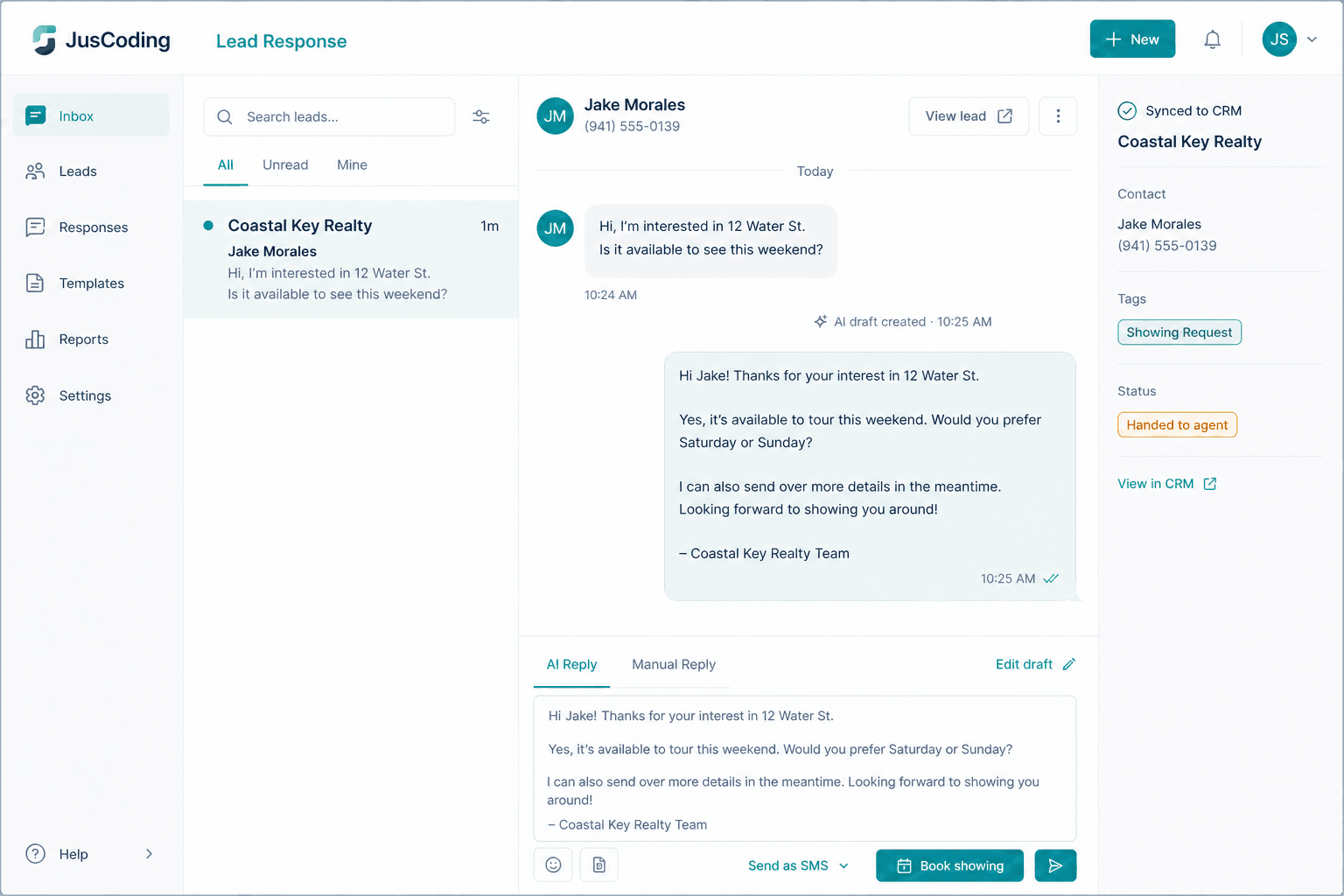
The MIT/Harvard research on online lead response is brutal: response inside five minutes is over 100 times more likely to qualify the lead than a response inside 30 minutes. Most small businesses respond in hours. Some in days. A lead-response automation reads the inquiry, qualifies it, sends a real first-touch reply, books the meeting if the lead is hot, and notifies you with the context already digested.
This is most valuable for real estate brokers, HVAC companies, and any business where a web form fill is worth $500+ in lifetime value. The build pays for itself in roughly six to twelve weeks for most B2C service businesses.
3. Operations bots
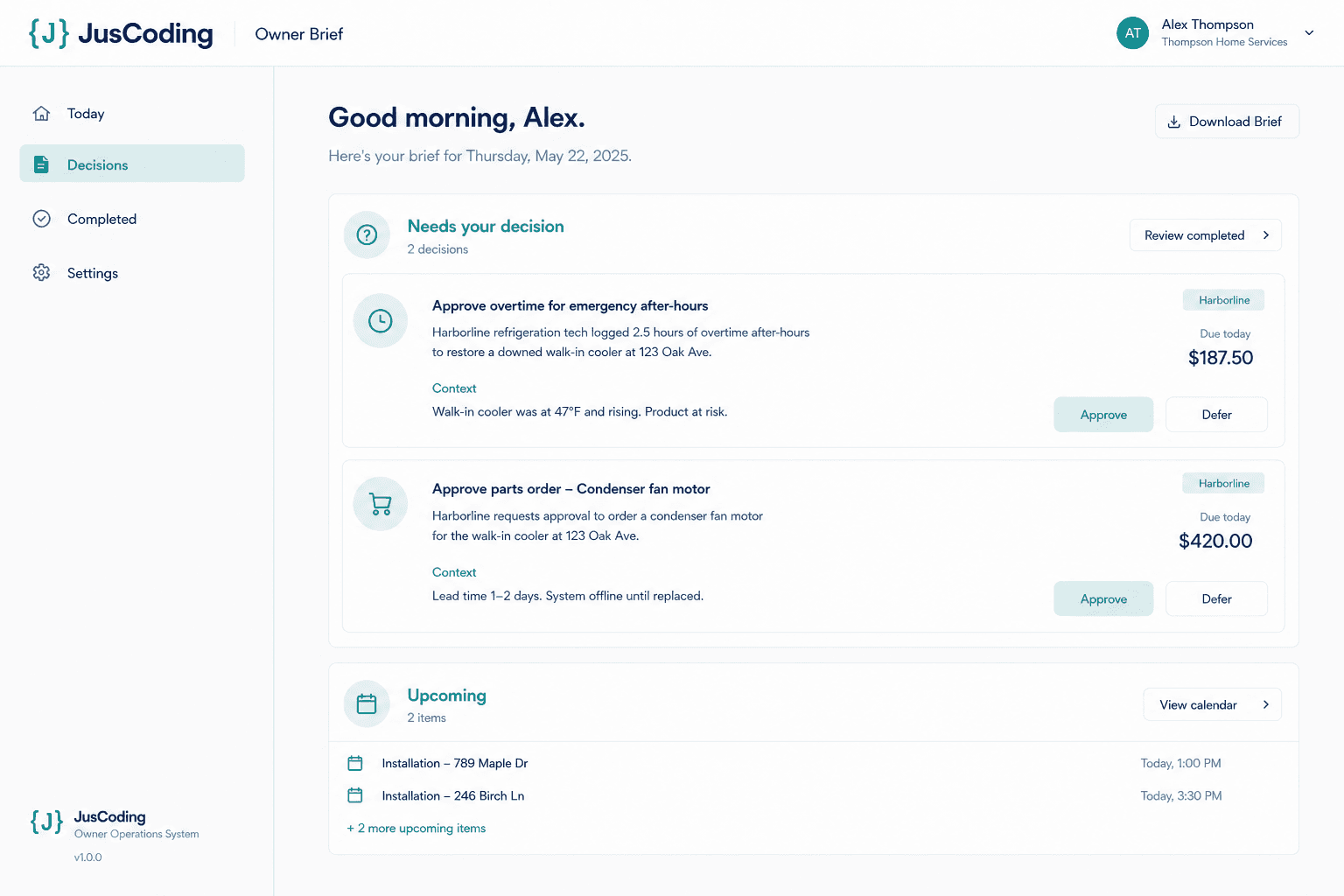
The unglamorous part. Things that quietly do the recurring work nobody wants. Pulling daily reports out of three different systems and emailing the summary. Reformatting purchase orders. Reconciling appointment lists across two platforms. Watching a folder for new files and sorting them. Sending the right text message to the right client at the right time, every time, without somebody having to remember.
Operations bots rarely sell themselves. But once you have one running, you stop being able to imagine running the business without it.
How a build actually goes.
Three steps. Same for every project.
1. Book the 20-minute call
Tell me about one bottleneck. The thing that wakes you up at 3am, or the thing that costs you the most in calls you're not catching, or the thing your front desk hates doing. I diagnose it on the call. No pitch, no "discovery process," no slide deck.
2. Live demo, customized to your business
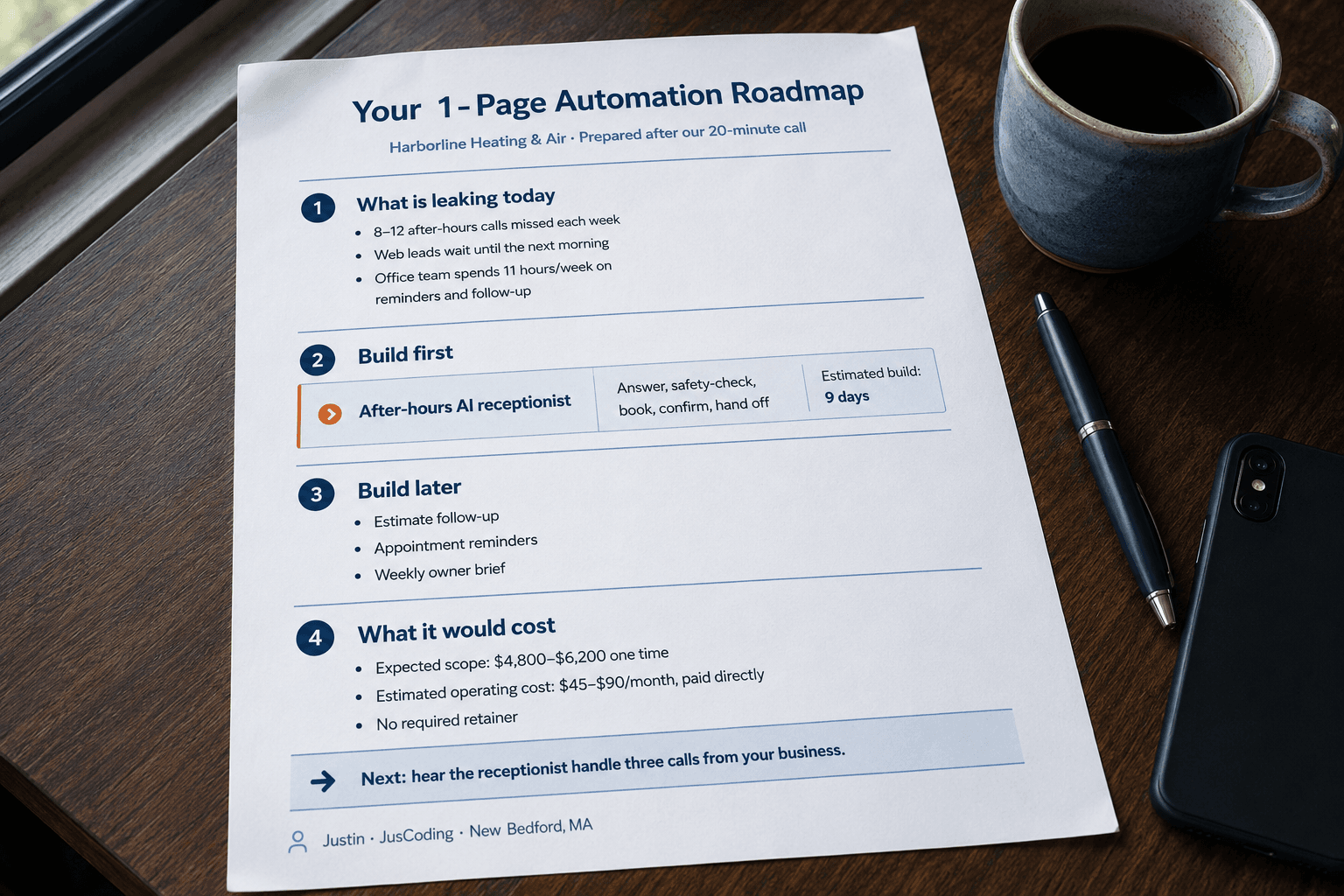
While we're talking, I pull up a working version of the relevant automation, configured with your actual scenarios. You see it run. You hear it answer a call (if it's a voice system). You leave the call with a clear picture of what we'd build together and a one-page roadmap. This part is the part nobody else does.
3. I deliver in 7 to 14 days
If you want me to build the full system, I quote a flat fee, deliver in two weeks, and hand you the keys. Code in your repo. Accounts in your name. Plain-English documentation for your team. 60 days of support included. You can hire any developer on Earth to take it from there if you ever want to.
Start with the $200 audit.
15 minutes describing your business. I send back a one-page playbook of the top 3 automations you'd benefit from, ranked by impact, with honest cost estimates for both subscription and custom-built options. The $200 credits 100% toward a build if you hire me.
Book the audit →What it costs.
Three packages. All flat fee. No required retainers, ever.
Audit
15-minute call plus a written one-page roadmap. Top 3 automations to build, ranked by impact and cost. Credits toward a build if you hire me.
Custom build
1 to 3 custom AI systems built from scratch. Live in 7-14 days. Code in your repo. Accounts in your name. Plain-English documentation. 60 days of support.
Bespoke
Multi-system or enterprise builds. Custom scoping call. 14-21 day delivery. 90 days of support. Quote after we map the scope together.
Optional ongoing support after delivery is $200-$400/month and is cancellable anytime. Most clients don't need it. The system runs on your accounts; if it breaks, you can call me or any other developer.
Who this is for.
Not every business should buy custom AI right now. The build pays back fastest for service businesses where:
- Phone calls drive revenue and you're missing some of them (dental, HVAC, plumbing, auto service, legal intake, real estate)
- Web form leads are worth $500+ in lifetime value and your response time is over 30 minutes
- You have 5 to 50 employees and one or two roles spend a meaningful chunk of their week on repetitive admin
- You'd rather own the system than rent it from Arini, Smith.ai, Goodcall, or Dialzara forever (the math on this gets brutal after month 12)
If you're a one-person business that gets two calls a day, you don't need this. I'll tell you that on the call. The audit is still useful: it usually finds one thing worth doing manually.
Use cases I see most.
After-hours AI receptionist + appointment booking
Captures the new-patient calls happening between 5pm and 8am. Books cleanings directly into the practice's existing scheduler. Routes urgent issues (cracked molar, abscess) to the on-call number. Pays back in roughly four to six weeks for most practices losing $8K+/month to missed calls.
Sub-five-minute lead response with qualification
Reads inbound web inquiries (Zillow, broker site, IDX), replies with a real personalized first-touch inside three minutes, qualifies the lead with a few smart questions, and books the showing if the lead is hot. The MIT 5-minute rule made literal.
After-hours call capture, dispatch routing, follow-up
Industry data has after-hours missed-call rates over 90% for residential HVAC. The build catches those calls, takes the address and the symptom, and either books a morning appointment or escalates to the on-call tech with the full context.
Intake, conflict check, scheduling
Replaces the front-desk-and-paralegal version of intake. Walks the prospective client through a 10-minute intake, runs a conflict check against your client list, and schedules the consultation if cleared. Lawyer reviews the file before the call instead of doing intake on the call.
Book the call. I'll demo a build for your industry.
The demo on the discovery call is the part nobody else does. By the end of the 20 minutes, you've heard a working version of the relevant automation tailored to your business. If it doesn't impress you, you don't hire me.
Book the 20-minute call →Common questions.
How is custom-coded AI different from Arini or Smith.ai?
Subscription AI receptionists charge $99-$975/month forever and you never own the system. A custom build is $2,400-$7,500 one-time, runs in your accounts, and after twelve months has already saved you money compared to subscription pricing. The math is broken out here.
What if I'm not technical?
Every build comes with plain-English documentation and a walkthrough video for your team. The system runs on your accounts (your phone number, your scheduler, your CRM), so if you ever want to take it to another developer, you can.
Do you serve businesses outside New Bedford?
Yes. I work across the South Coast (Dartmouth, Fairhaven, Acushnet, Mattapoisett, Westport, Marion, Wareham, Fall River) and the wider Massachusetts area. Outside MA, work happens over Zoom. I prioritize MA businesses because I can meet you in person if it matters.
What if your demo doesn't impress me?
Then you don't hire me. You walk away with a one-page roadmap and a clear picture of what's possible. The 20 minutes were free. I'd rather lose the deal than push a system on someone who isn't sure.
— Justin, from a converted spare bedroom in New Bedford