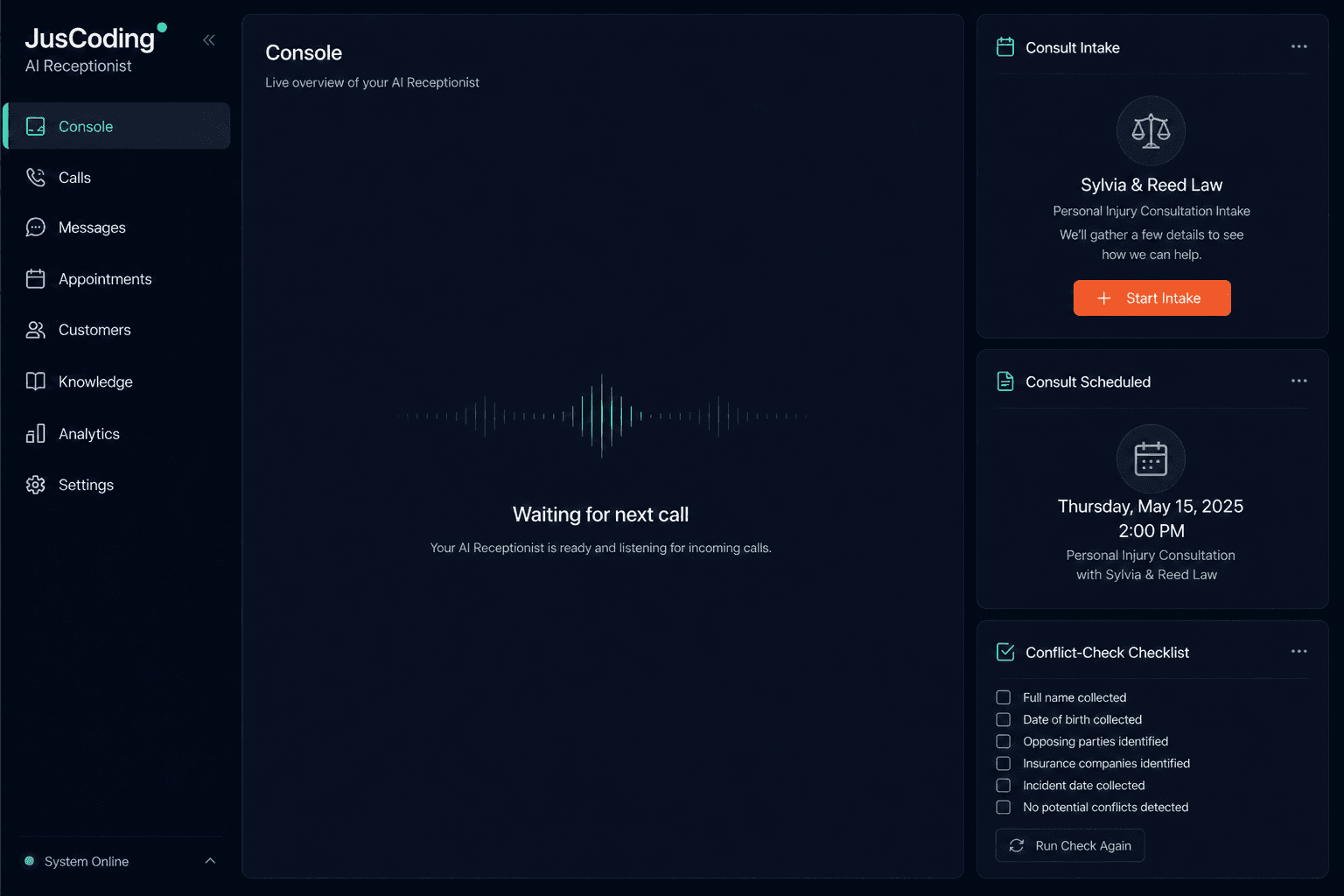
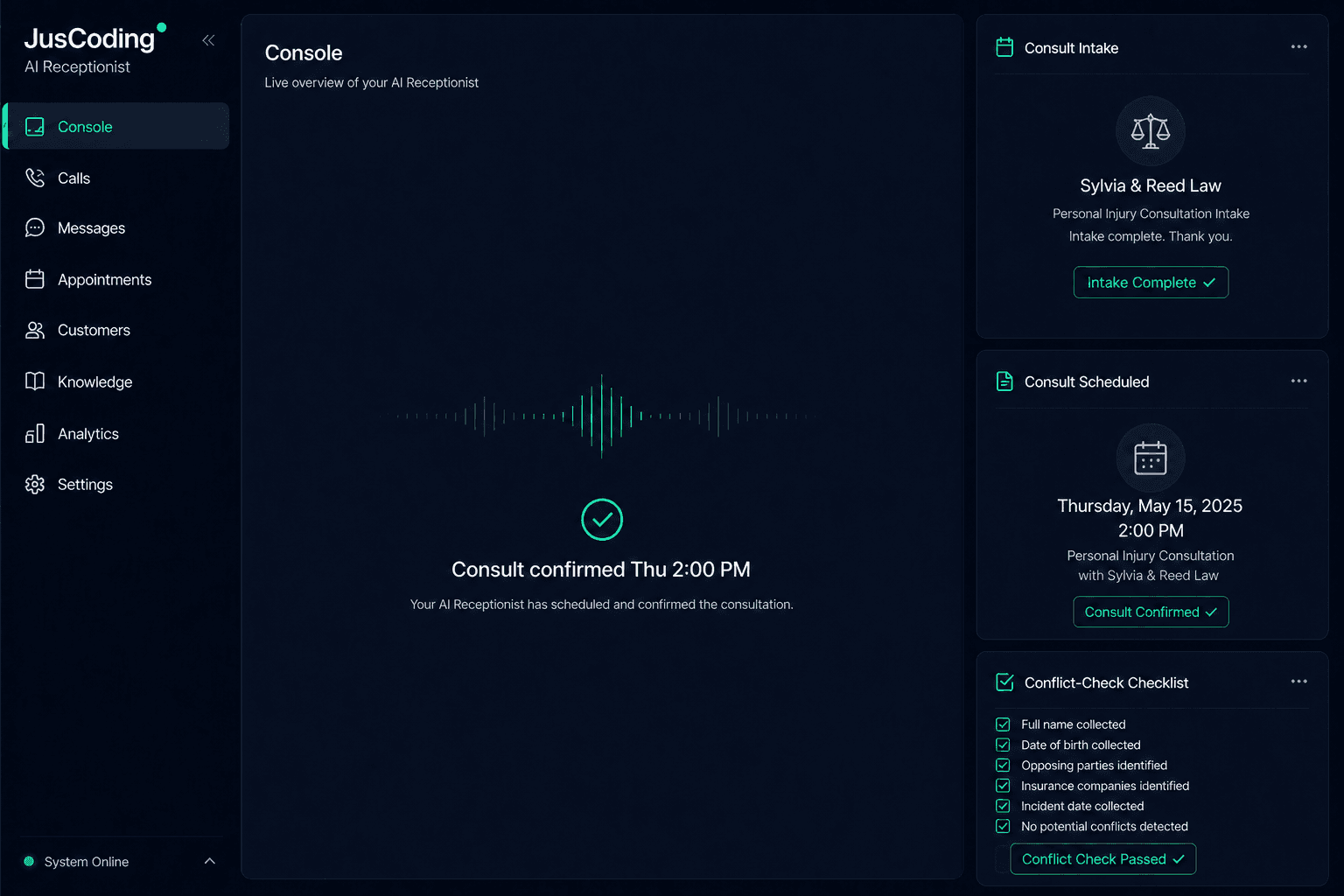
The economics of intake at a small law firm are awful. The prospective client calls. Your front desk picks up if they're not already on another line. They take a name and a one-sentence summary. They route to a paralegal or to you. You schedule a 30-minute consultation. You spend the first ten minutes of that consultation gathering basic information that should have been gathered before. Half the consultations end with "actually that's not really what I do."
Multiplied across a year, this is hours of unbillable intake time per week, lots of consultations on cases you can't take, and a meaningful number of inbound calls that just get lost. The right intake automation pays for itself in the time it saves alone, before counting the cases it surfaces that would otherwise have walked.
What I'd build for a solo or small firm.
Three pieces. Most firms start with the first.
1. AI intake conversation
An AI that handles the prospective-client intake call (or the chat on your website, or the form follow-up) and walks the caller through a real 10-minute intake conversation. Captures the legally relevant facts, the timeline, the parties involved, the prior representation history. Recognizes when the matter is outside your practice areas and politely declines (or refers, if you maintain a referral list). Recognizes urgency (statute of limitations approaching, court date imminent) and routes accordingly.
By the time the call hits your calendar, you have a written intake summary. You walk into the consultation already knowing the case shape, the conflict status, and whether it's worth your time.
2. Conflict checking against your client database
The system queries your practice management software (Clio, MyCase, Smokeball, PracticePanther, Rocket Matter) for the prospective client's name and any opposing parties they mention. Any potential conflict pauses the booking and pings you for human review before the consultation is scheduled. Saves you from the awkward "actually we have to decline" conversation in a paid consultation.
3. Consultation scheduling and pre-meeting prep
Once cleared, the system books the consultation directly into your calendar in a slot that makes sense for the matter (longer for a family law dispute, shorter for a quick estate-planning review). Sends the prospective client the engagement-letter draft to review beforehand if appropriate. Drops the intake summary into your matter file so you can prep in five minutes instead of thirty.
How it plays out.
From 12 hours/week of intake to 3.
Solo estate-planning attorney with a single paralegal who handled most intake. Spent ~12 hours a week on intake-related work between calls, follow-ups, conflict checks, and consultations that turned out to be matters she couldn't take (probate disputes she didn't litigate, business formation questions outside her scope).
Build: AI intake on her main intake line and chat on her Clio-hosted website. Walks prospective clients through a 10-minute conversation, runs the conflict check against Clio, books cleared consultations directly. Hands her a one-page case summary in the matter file before the consultation.
Captured 27 weekend intakes in Q1 that previously rolled to voicemail.
Two-attorney PI firm with strong local referrals and a busy weekend phone. Voicemail-only after hours and weekends. Owner suspected losing real cases (car accident calls especially happen on weekends) but didn't have data.
Build: AI intake on the after-hours line. Walks the caller through accident-specific intake (date, location, parties, injuries, current medical care, insurance company), captures everything in writing, and books a Monday morning consultation with the relevant attorney. Critical statute-of-limitations cases (close to the 3-year MA limit on personal injury) flag immediately.
Start with the $200 audit.
15 minutes describing your firm, your practice management software, and your current intake workflow. I send back a one-page playbook with what to build, what it'd cost, and a real estimate of recovered hours per week. The $200 credits if you hire me.
Book the audit →What it costs.
Firm audit
15-minute call plus written playbook. Real estimate of intake hours recovered. Credits toward build.
AI intake build
AI intake conversation + conflict checking + consultation scheduling. Integrated with your practice management software. Live in 10-14 days. 60 days of support.
Intake + matter prep
Everything above plus pre-consultation matter prep (engagement letter draft, intake summary in matter file, suggested billing-rate quote). For firms taking 5+ consultations per week.
Compared to legal-specific subscription intake tools ($199-$799/month), a custom build pays back inside 12-18 months and you own it.
What about privilege and ethics?
Two questions usually come up first. Worth addressing directly.
Privilege. Attorney-client privilege does not attach in the same way at the prospective-client intake stage as it does post-engagement. Most jurisdictions recognize a more limited duty of confidentiality to prospective clients, which the system is designed to respect: encrypted intake conversations, signed BAAs and zero-retention agreements with the model provider, no PHI or sensitive data sent through non-compliant tools, and explicit handoff to you for anything resembling legal advice. Your bar's specific rules govern; the build is configured to your jurisdiction.
UPL (unauthorized practice of law). The AI does not provide legal advice. It gathers information, checks for conflicts, and books consultations. It explicitly declines to opine on the merits of the matter, recommend a course of action, or estimate damages. The line is drawn deliberately, and the system has guardrails for the cases when prospective clients try to push it.
FAQs from attorneys.
Will it integrate with Clio, MyCase, or Smokeball?
Yes. Clio, MyCase, Smokeball, PracticePanther, and Rocket Matter all have APIs. The build creates the prospective-client matter, runs the conflict check, and books the consultation directly into your practice management software.
What if the prospective client describes a fact pattern outside my practice?
The system recognizes this and either offers a referral list (if you maintain one) or politely declines and books no consultation. You do not get stuck billing a free hour to someone whose case you cannot take.
How does the conflict check work?
The system queries your contact and matter database for matches against the prospective client's name and any opposing parties they mention. Any potential conflict pauses the booking and pings you for human review before scheduling. The check is fast but you have the final call.
What if it sounds robotic and ruins my firm's reputation?
It does not. Modern voice AI sounds like a person, and the persona is configured to match your firm's tone. The intake reads as professional, careful, and competent. Most prospective clients do not realize they are talking to AI on the first interaction. We tune it on a sample of your typical intake calls.
How long until it's live?
10-14 days for most builds. The discovery call includes a working demo on a representative intake (we use a synthetic case in your practice area). 7-10 days of build, 2-4 days of testing alongside you on real intake before going live.
Small-firm inbound call answer rates: Clio Legal Trends Report (annual) and supporting research from Hennessey Digital, ATL, and ABA TECHREPORT.
Practice management API access verified against current Clio, MyCase, Smokeball, PracticePanther, and Rocket Matter documentation.
Massachusetts personal injury statute of limitations (MGL c. 260, § 2A): 3 years.
Book the 20-minute call. I'll demo a legal intake live.
By the end of the call, you've heard the AI handle a real intake conversation in your practice area, run a conflict check, and book a (sample) consultation. If it doesn't impress you, you don't hire me.
Book the call →— Justin, from a converted spare bedroom in New Bedford