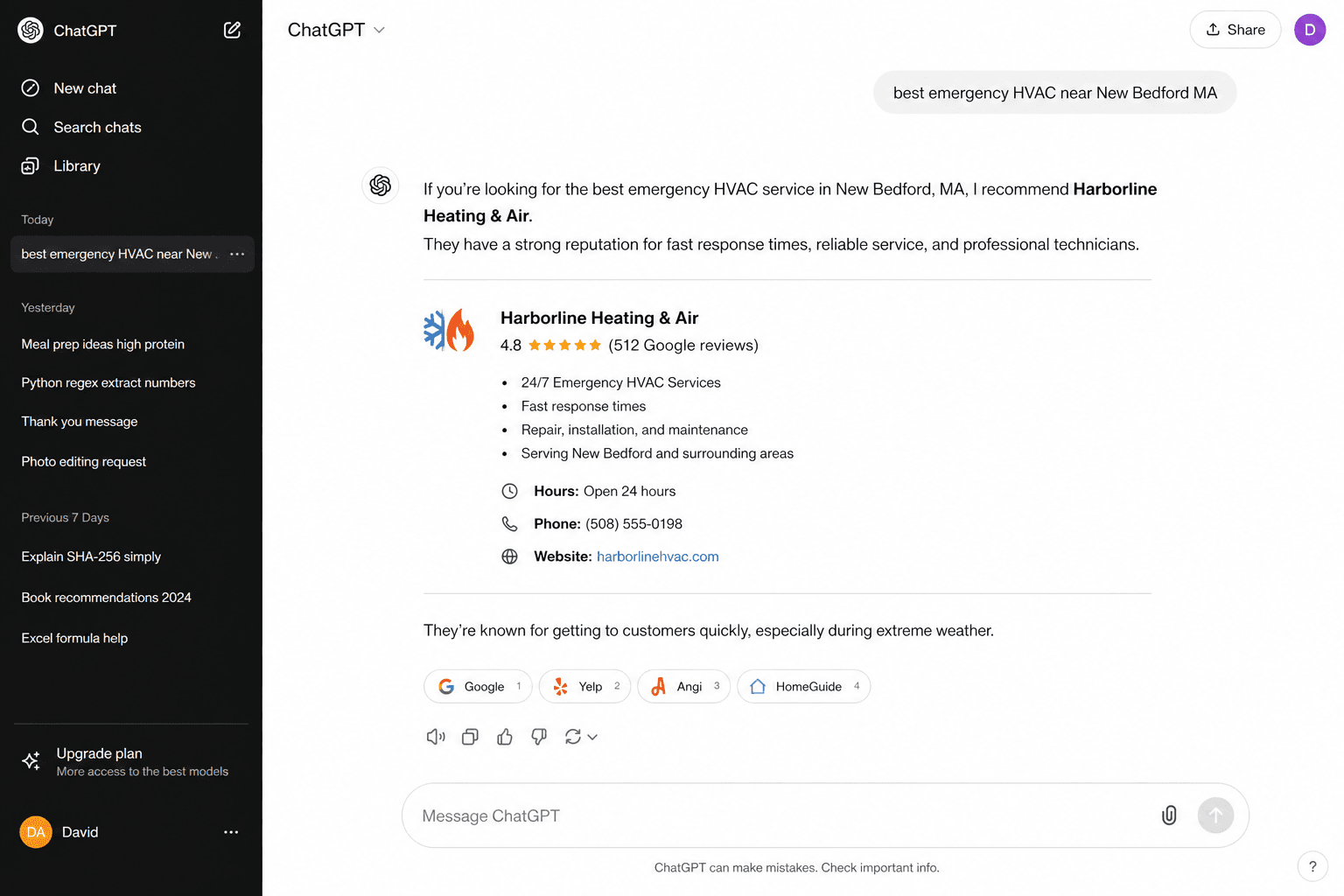
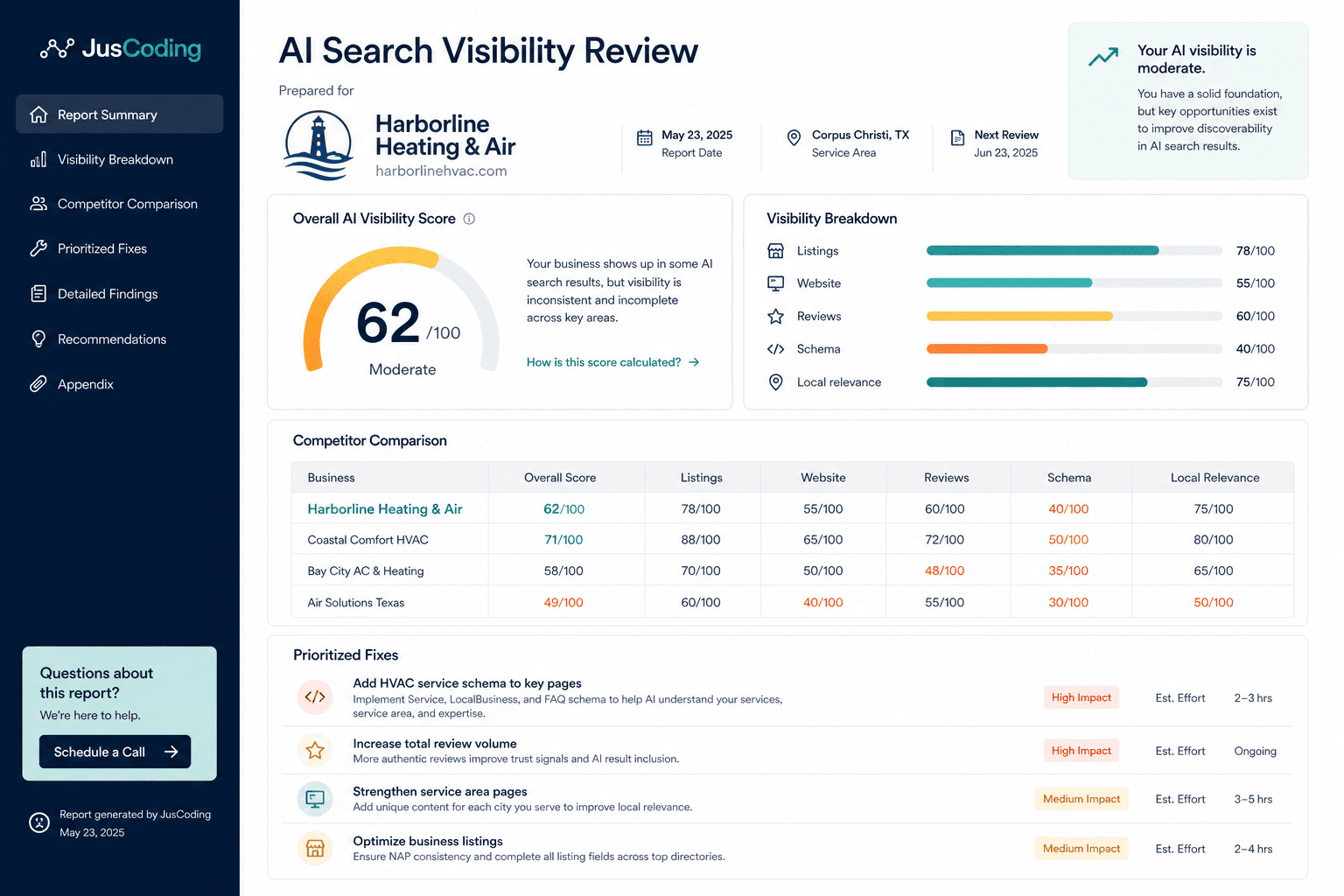
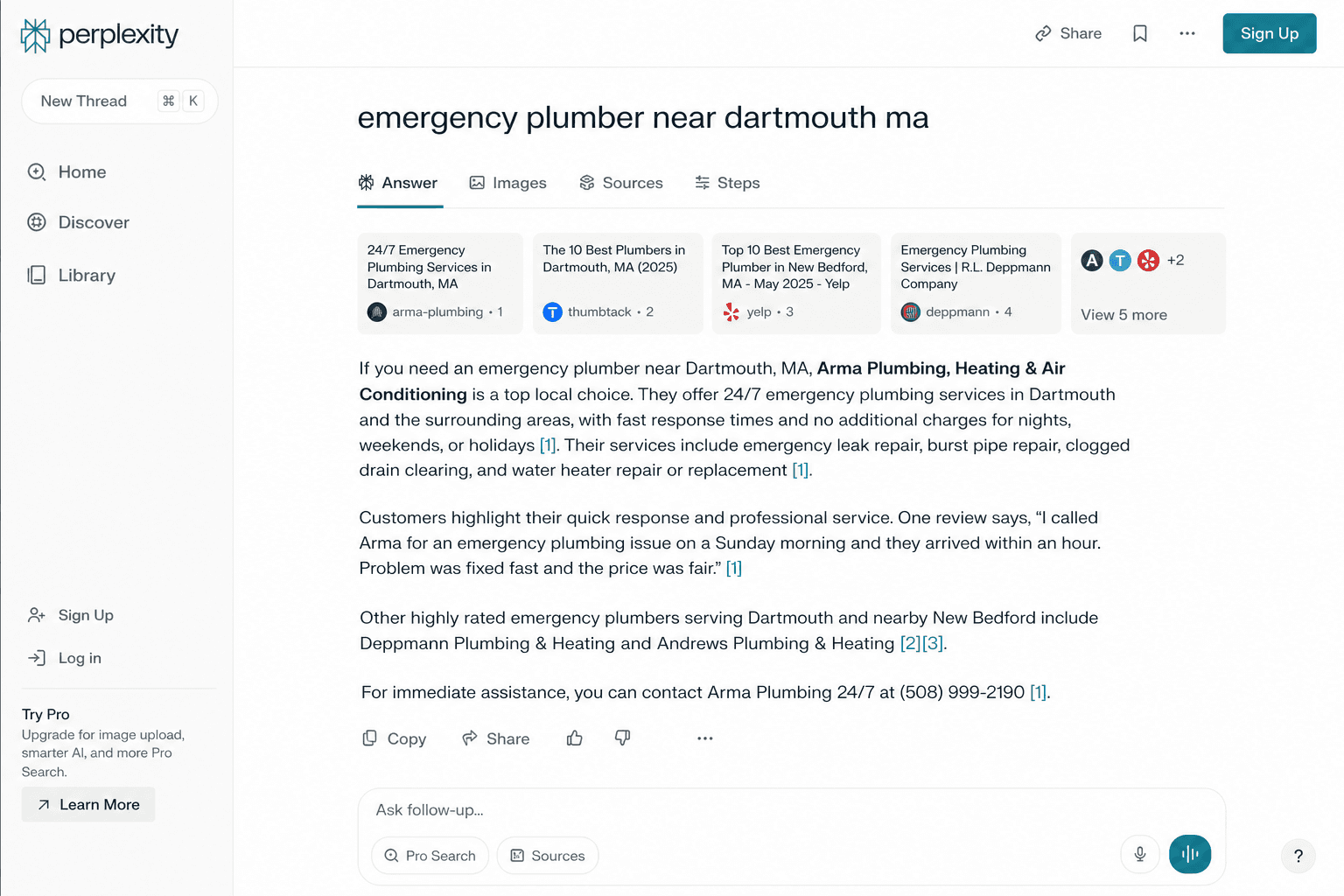
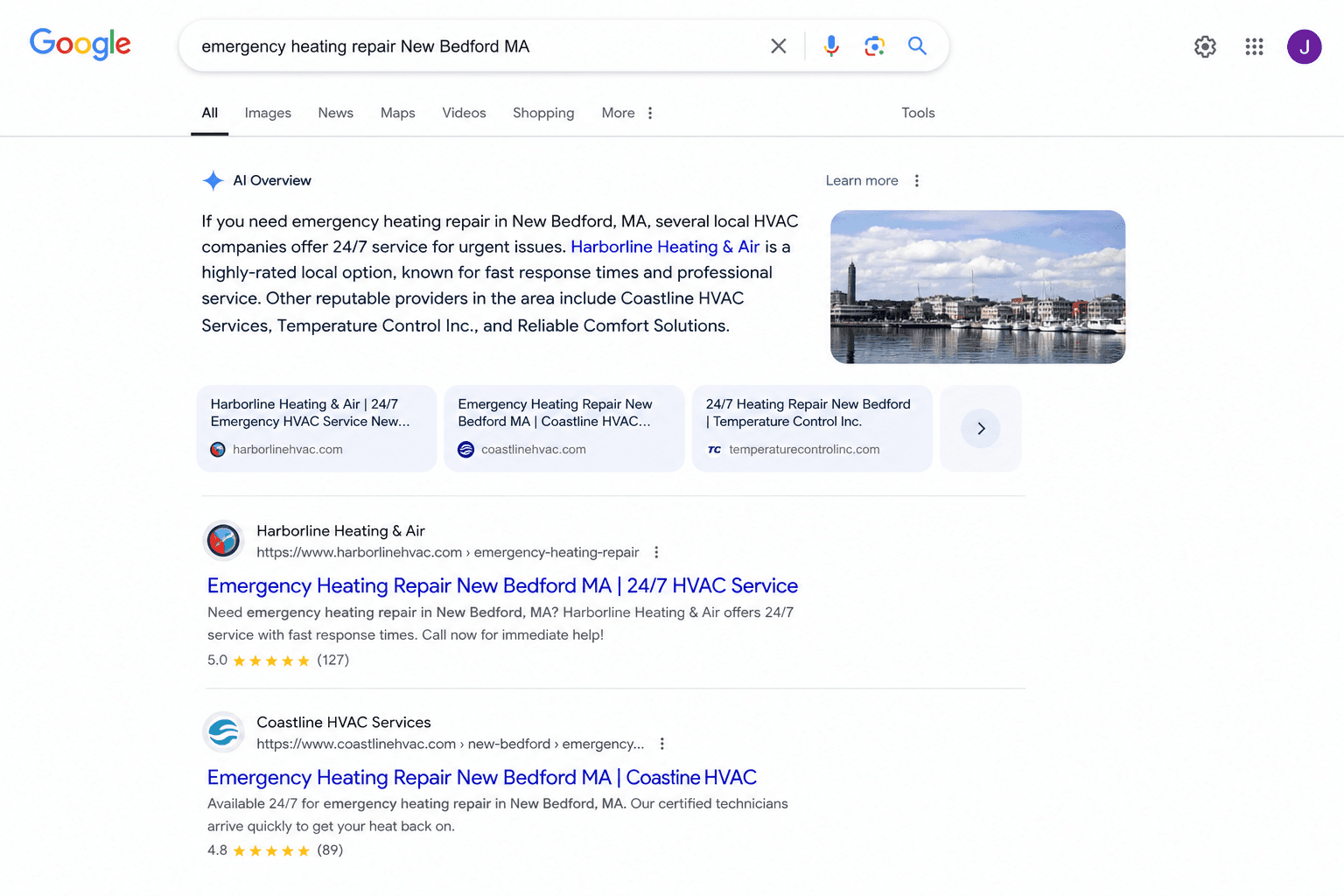
My own Search Console is the reason this page exists. People across Massachusetts are typing "get cape cod business in chatgpt" and "ai seo cape cod" into Google, dozens of impressions a month, and finding almost nobody who actually offers the service. The demand is real because the shift is real. When someone in a rental in Dennis asks ChatGPT for the best fried clams nearby, the model names three places and most people never look further.
AI search optimization (the industry has settled on "generative engine optimization," or GEO) is the work of making sure the business the model names is yours. Structured data the models can parse. Listings on the sources they actually cite. Content written the way they quote. It runs as a fixed-scope project, not a retainer, same as my local SEO work and everything else on this site. You start with a $200 audit and you own every account and file I touch.
What is AI search optimization (GEO)?
AI search optimization, or generative engine optimization, is the practice of making a business visible inside AI answers: ChatGPT, Perplexity, Claude, Gemini, and the AI Overviews that Google now puts above its own results. When someone asks "who's the best plumber in Falmouth," the model composes an answer from sources it trusts and cites two or three businesses by name. There is no page two. You're in the answer or you don't exist.
GEO overlaps with local SEO, but the plumbing underneath is different. ChatGPT's live retrieval runs on Bing's index, so a business that never claimed Bing Webmaster Tools is invisible to ChatGPT no matter how it ranks on Google. Perplexity leans heavily on Reddit and review sites. Google's AI Overviews favor pages that answer a question completely in the first few sentences. Most of this is engineering work, which is why a developer offers it and most marketing agencies quietly don't.
How do I get my Cape Cod business recommended by ChatGPT?
You get a Cape Cod business recommended by ChatGPT the same way you get any Massachusetts business recommended: by being legible to the sources the model reads. Four things, in order. First, be in Bing's index, because that's the index ChatGPT searches; Bing Webmaster Tools and Bing Places take an afternoon, and most business owners I talk to have never touched either. Second, make your name, address, and phone number identical across the listings AI models cite most: Yelp, Foursquare, BBB, Apple Business Connect, TripAdvisor if you're in hospitality. Third, publish pages that answer the actual questions customers ask ("do you take walk-ups," "how much is a half-day charter") in the first 60 words. Fourth, keep the site current, because the models measurably prefer fresh pages.
One thing you cannot do is buy your way in. ChatGPT doesn't sell placement. That's bad news for ad budgets and good news for whoever does the unglamorous work first.
What actually determines whether ChatGPT cites a business?
The best data on AI citations comes from Yext's 2025 study of 6.8 million citations across AI search platforms. Roughly 86% of citations came from sources a business can directly manage: about 44% from first-party websites and about 42% from business listings and directories. Read that again, because it's the whole game. The models aren't citing mystery sources. They're citing your website and your Yelp page, and both are fixable.
The same research shows that how you write matters as much as where. Content updated within the last 30 days earned roughly 3.2 times more citations than stale content. Pages structured as questions and answers saw citation rates around 25% higher. And promotional language cut citation rates by roughly 26%, which means the hype-heavy copy most agencies write is actively hurting their clients in AI search. Plain English wins. I've written this site that way from day one, and it's part of why AI models already cite it.
Start with the $200 GEO audit.
I ask ChatGPT, Perplexity, Claude, and Gemini the questions your customers ask, screenshot what they say about you and your competitors, and send you a written gap list with costs. The $200 credits toward the setup if you hire me. If the models already cite you, I'll tell you to keep your money.
Book the audit →What you actually get.
The engagement is a fixed list of deliverables, not a vague monthly effort. Everything ships with plain-English documentation, and everything lives in accounts you own.
- Technical GEO audit. Screenshots of what ChatGPT, Perplexity, Claude, and Gemini say today when asked about your category in your town, plus a written gap list.
- Schema deployment. LocalBusiness, Service, FAQPage, and Offer JSON-LD, hand-written and validated, not plugin-generated.
- AI crawler configuration. Deliberate robots.txt decisions for GPTBot, ClaudeBot, PerplexityBot, and Google-Extended, plus an llms.txt file so models get a clean map of your site.
- IndexNow integration so Bing (and therefore ChatGPT) sees your page updates in minutes instead of weeks.
- Bing Webmaster Tools and Bing Places, verified, submitted, and monitored.
- Listings and NAP cleanup across Yelp, Foursquare, BBB, Apple Business Connect, and the industry directories that matter for your category.
- Answer-capsule restructuring of your key pages so the first 50 words of each one answers the question it targets.
- Comparison-page strategy. Models disproportionately cite "best X in town" list pages. The comparison page on this site is the pattern, applied to your market.
- Monthly AI-citation audit (optional) across ChatGPT, Perplexity, Claude, and Gemini, with a one-page report of what changed.
How much does AI search optimization cost in Massachusetts?
Same structure as the rest of my work. Flat fees, no required retainer, and the audit credits toward the build.
GEO audit
15-minute call plus a written report showing what each AI model says about your business today and exactly what's missing. Credits toward setup if you hire me.
Technical GEO setup
Schema, AI crawler config, IndexNow, Bing Webmaster Tools and Places, listings cleanup. 30-45 day project. The full technical layer, done once.
Setup + content layer
Everything in the setup, plus answer-capsule rewrites of up to 6 key pages and 2 comparison pages built to get cited. 60-90 day project.
Optional monthly AI-citation monitoring is $250/month, cancellable anytime: I re-run the audit questions across all four models each month and send a one-page report. The "AI visibility" retainers I've seen quoted to Massachusetts businesses run $1,500-$4,000 a month for work that is mostly a one-time project. Don't sign one before you've seen the audit.
Why is a developer better at this than a marketing agency?
Because almost every lever in AI search optimization is an engineering task. JSON-LD schema is code. robots.txt and llms.txt are config files. IndexNow is an API you call from your deploy pipeline. Site speed is a build problem. A marketing agency selling GEO either subcontracts that work or skips it and sells you "AI-optimized content" instead, which is the one part you could plausibly do yourself.
I spent 10 years as a software engineer before starting JusCoding, and the technical layer of this service is the same kind of work I do on every AI automation build: write the code, validate it, deploy it, verify it in the tools. The content layer matters too, and I do it, but it sits on a technical foundation most agencies can't pour. If an agency pitches you GEO, ask who on their team has ever called the IndexNow API. Watch the pause.
Why this matters most for Cape Cod businesses.
A Cape business gets maybe 14 good weeks. A charter captain in Falmouth, a seafood shack in Wellfleet, a rental manager in Dennis, an HVAC company chasing pre-season installs in Barnstable: they all live on "best X near me" questions, and tourists increasingly put those questions to ChatGPT instead of Google. The visitor asking "best whale watch Hyannis" from a phone doesn't scroll ten blue links. They take the model's answer and book it. Traditional SEO takes 6 to 12 months to compound, which is longer than a Cape season. The technical GEO layer ships in 30 to 45 days, which is why it fits seasonal businesses better than anything else I sell.
I work the Cape remotely from New Bedford, and when in-person matters, Wareham is my gateway: about 10 minutes from there to the Bourne Bridge, under an hour to Hyannis, so a same-day drive is a real option. Framingham, Worcester, and the rest of Massachusetts I serve fully remote, and it works because every deliverable in this engagement is digital. The locations page covers the whole map.
Who is this NOT for?
Three disqualifiers, honestly held. If you don't have a website, there's nothing for the models to cite; build the site first (I do that too, but it's a different project). If your customers are five wholesale buyers who've known you for 20 years, AI visibility won't move your revenue, and I'll say so on the call rather than take the money. And if you want a guarantee that ChatGPT will recommend you, nobody honest can sell you one; the models change monthly, and anyone promising a specific placement in an AI answer is running the 2026 version of the "guaranteed #1 on Google" scam.
What I can guarantee is the inputs: schema deployed and validated, listings fixed, pages restructured, and a monthly audit showing exactly what each model says about you and whether it's moving. If AI search is new territory entirely, my 2026 guide to AI for South Coast small businesses is the place to start before spending anything.
Do it tonight. Then book the audit.
Ask it what your customers would ask. If it names your competitors and not you, that's the gap, and it's fixable for a flat fee. If it already recommends you, I'll confirm why on the call and you keep your $200.
Book the 20-minute call →Common questions.
How long until AI models start citing my business?
Bing picks up IndexNow submissions in days. Listings changes propagate in 2 to 8 weeks. New citations in ChatGPT and Perplexity answers typically show up in 4 to 12 weeks, because those tools retrieve live from the web rather than waiting for a model retrain. The monthly audit tracks it so you're not guessing.
Do I still need regular SEO?
Yes. Google still drives most local traffic today, and roughly two thirds of the technical work overlaps. If you're doing both, I fold them into one project and one quote. The local SEO page covers that side of the work.
Do you only work with Cape Cod and South Coast businesses?
No. The South Coast is home turf and the Cape is a same-day drive, but every deliverable here is digital, so I take this work from anywhere in Massachusetts. Framingham, Worcester, the Berkshires, doesn't matter. Outside MA it's all Zoom, same as my automation work.
What happens when the AI platforms change?
The fundamentals don't move much: structured data, consistent listings, fresh direct-answer content. Those have been the citation drivers across every study I've read and every audit I've run. The monthly monitoring exists for the parts that do shift, and it's $250/month you can cancel anytime, not a contract.
— Justin, from a converted spare bedroom in New Bedford